


Artwork Details
- Title
- The Thinker
- Artist
- Auguste Rodin (1840 – 1917)
- Year
- modeled 1880–81; enlarged 1902–04; cast 1919; installed 1929
- Medium
- Bronze, on concrete and limestone bases
- Dimensions
- Height 6'7″, width 4'3 1/4″, depth 4'7 1/4" (base height 6'1 3/4", width 5'10 1/2")
Artwork Description
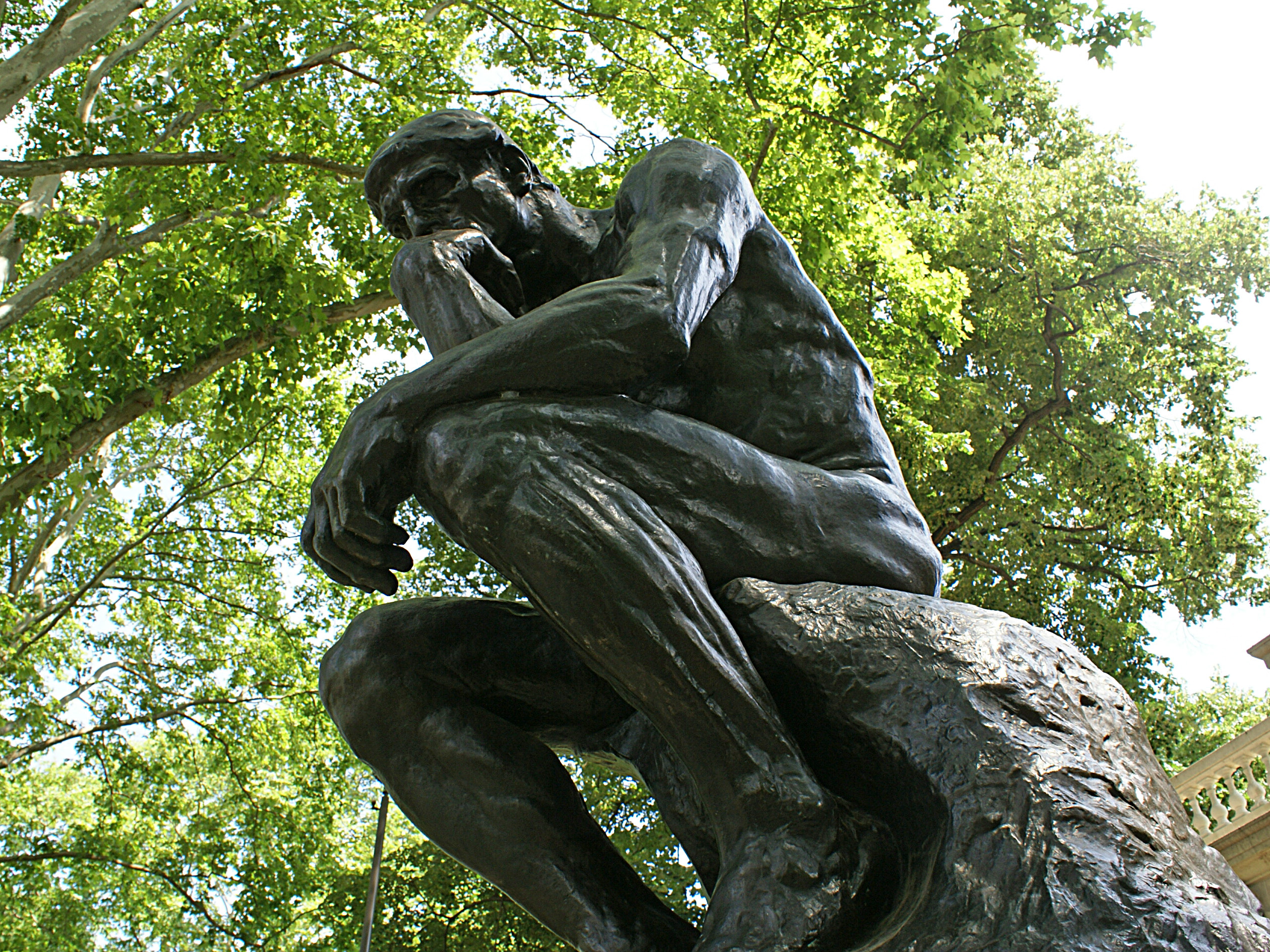
The large version of The Thinker was exhibited in Paris in 1904, to so much acclaim that funds were raised to purchase it for the city. This was a time of great social and political turmoil in France, and when the sculpture was installed in front of the Panthéon in 1906, Rodin interpreted it as a “social symbol” magnifying “the fertile thought of those humble people of the soil who are nevertheless producers of powerful energies.” In the years thereafter, it may have acquired other meanings for him as well. When his wife died in 1917, he had a cast of The Thinker placed on her grave at Meudon, in front of the ruined façade of an old chateau that Rodin had purchased and installed there. At the same site Rodin himself was buried a few months later.
Philadelphia’s Thinker is a cast of the 1902–1904 version. It was installed for the opening of the Rodin Museum in 1929, in front of a façade that replicates the one at Meudon, so that together the sculpture and façade match the arrangement at Rodin’s tomb.
Content on this page was adapted from Public Art in Philadelphia by Penny Balkin Bach (Temple University Press, 1992). Bach was the longtime Executive Director of the Association for Public Art, working with the organization from 1980 to 2022.
Artwork Credits
Gift of Jules Mastbaum
Owned by the Philadelphia Art Museum
Artwork Media
Museum Without Walls
Voices:
MARK DI SUVERO is a renowned sculptor who was deeply influenced by the work of Rodin.
JOSEPH J. RISHEL (1940-2020) was the longtime curator of European art at the Philadelphia Art Museum, as well as curator of the Rodin Museum.
Producer: Lu Olkowski