

Artwork Details
- Title
- The Schuylkill Chained and The Schuylkill Freed
- Artist
- William Rush (1756 – 1833)
- Year
- Spanish cedar originals c. 1825; casts 1980, installed 1989
- Medium
- White fiberglass
- Dimensions
- The Schuylkill Chained: height 3'3.5″; width 7'3.5″; depth 2'2.5″; The Schuylkill Freed: height 3'5.5″; width 7'3.5″; depth 2'6.5″
Artwork Description
As the Fairmount Water Works expanded in the 1820s, a wonder of contemporary engineering and a famous public garden, the city’s Watering Committee decided to embellish the site with emblematic sculpture. The members did not have to look far for an artist because William Rush, the foremost American sculptor of his era, served on the committee.
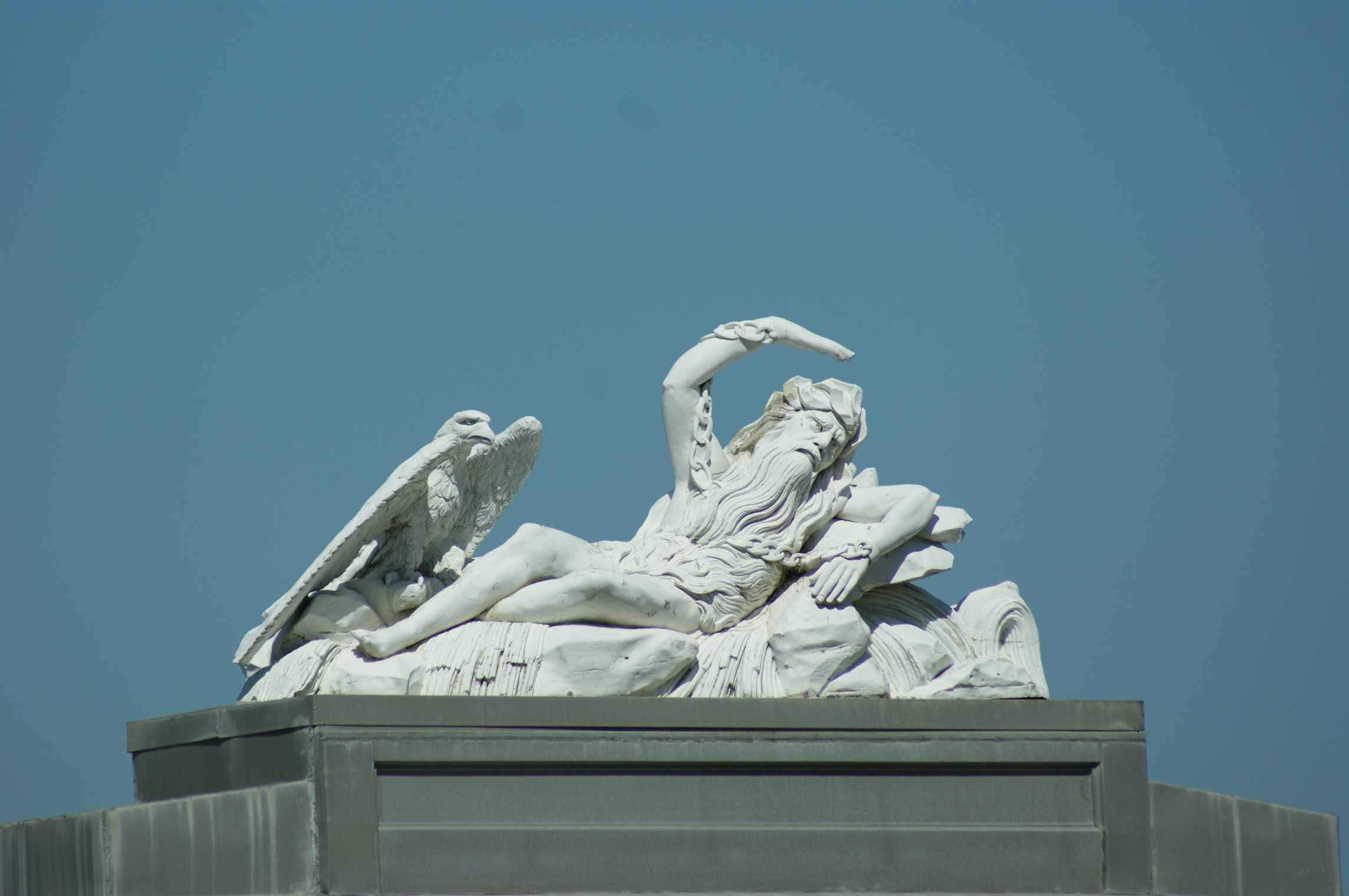
Rush designed two sculptures to be placed atop the entranceways to the new Fairmount millhouse, where visitors descended for a dramatic view of the gigantic water wheels churning below. The male figure, The Schuylkill Chained, was originally known as Allegory of the Schuylkill River in Its Improved State – a title that gives a clearer idea of Rush’s intentions. The female figure was originally called Allegory of the Waterworks. The allegory of the “improved” river draws on traditional representations of river gods, but Rush’s wild old man with flowing beard – the arms scarcely restrained by the chains of civic improvement – has a unique energy and strength.
Around the figure the waters gush out in many directions. Beside his feet is an American eagle, wings outspread. The female figure forms a sharp contrast. This classical young woman holds one graceful hand above a water wheel as if to demonstrate its elegance and power. Behind her, a large vase represents the Fairmount reservoir. Even her platform of bolted steel indicates the artifice of civilization.
Since 1937, Rush’s Spanish cedar originals have been in the Philadelphia Art Museum. In 1980, Association for Public Art (then known as Fairmount Park Art Association) had copies of the sculptures cast in white fiberglass in conjunction with the renovation of the Water Works. The casts were installed on the refurbished entrance houses in 1989.
Content on this page was adapted from Public Art in Philadelphia by Penny Balkin Bach (Temple University Press, 1992). Bach was the longtime Executive Director of the Association for Public Art, working with the organization from 1980 to 2022.
Artwork Credits
Spanish cedar originals commissioned by the Watering Committee of the City of Philadelphia
Fiberglass casts commissioned by Association for Public Art (formerly the Fairmount Park Art Association)
Owned by the City of Philadelphia
Artwork Media
Museum Without Walls
Voices:
DR. DAVID R. BRIGHAM is the CEO of the Historical Society of Pennsylvania and former President and CEO of the Pennsylvania Academy of the Fine Arts. He received his doctorate in American Civilization at the University of Pennsylvania.
KAREN YOUNG is the Director of the Philadelphia Water Department’s Fairmount Water Works Interpretive Center, which tells the story of the Schuylkill River and its human connections throughout history.
LINDA BANTEL is a curator and former Director of the Museum of the Pennsylvania Academy of Fine Arts. She is the author of William Rush, American Sculptor.
Producer: Ave Carillo