

Artwork Details
- Title
- Kwakwa̱ka̱ʼwakw Kwagu’ł House Post
- Artist
- Kwakwa̱ka̱ʼwakw Artist
- Year
- c. 1850
- Location
- NOT ON VIEW
- Medium
- Hand-carved western cedar wood
- Dimensions
- Approximately 12'6" high; approximately 1,000 pounds
Artwork Description
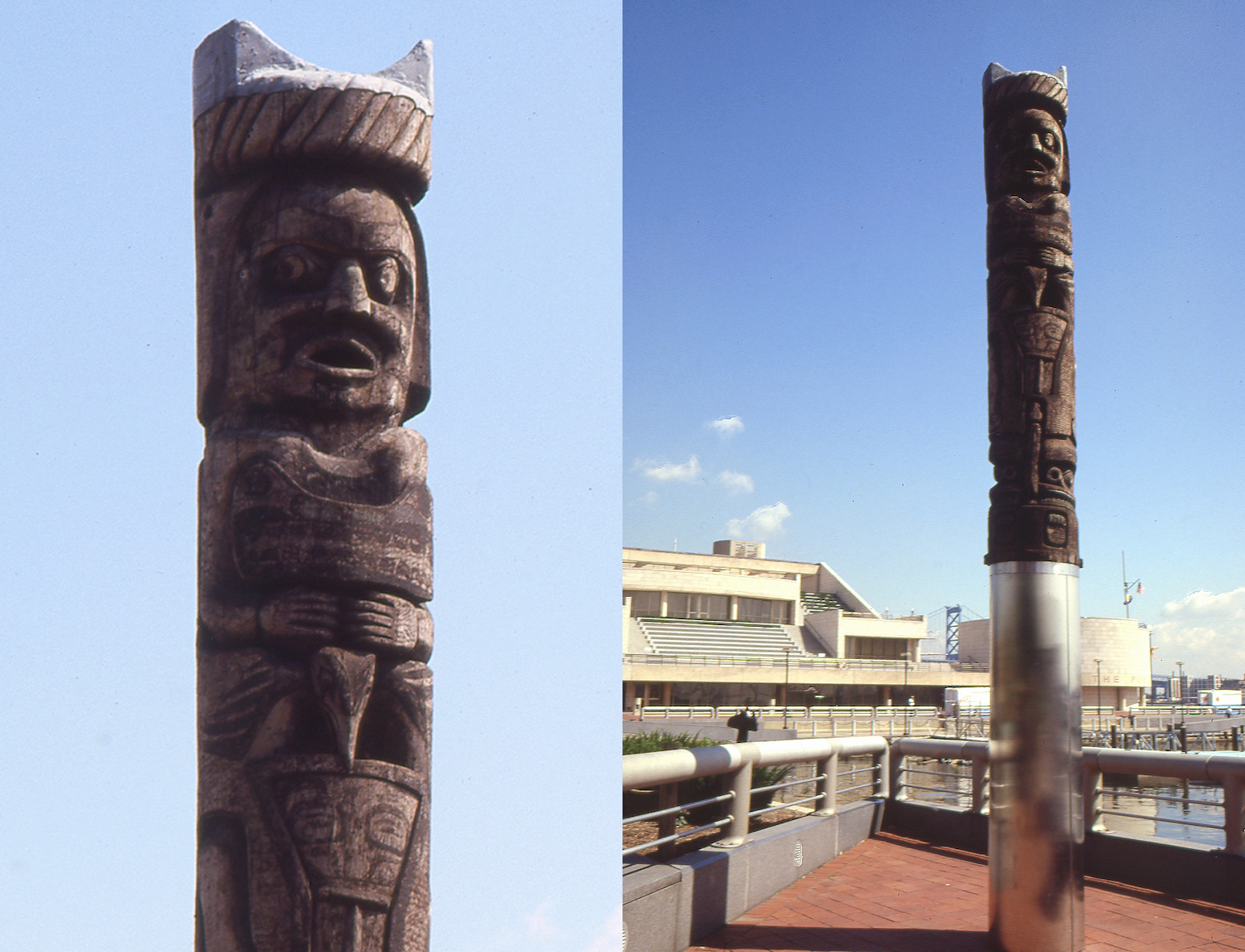
This house post was created by a Kwakwa̱ka̱ʼwakw artist in British Columbia circa 1850. Carved out of western cedar wood and standing approximately 12’6″ feet high, the 1,000-pound house post is an example of an art form unique to the First Nations people of the Pacific Northwest coast of British Columbia. The post was originally part of a pair used inside a community house to help support the roof. The companion house post is now in the collection of the Smithsonian Institution’s National Museum of the American Indian. Cedar pole carving continues to be practiced today as a living tradition that has been passed down through generations, providing a rich visual documentation of the Kwakwa̱ka̱ʼwakw cultural heritage.
Part of the First Nations people of Canada, there are approximately 18 Kwakwa̱ka̱ʼwakw tribes of Kwakʼwala-speaking people. The territory is spread over what is now referred to as the Mount Waddington Regional District–an area that includes Vancouver Island and many smaller islands and inlets of Smith Sound, Queen Charlotte Strait, and Johnstone Strait. An important element of the Kwakwa̱ka̱ʼwakw culture is the Potlatch, which features gift giving to guests, and ceremonial dances with masks and regalia.
The Kwakwa̱ka̱ʼwakw Kwagu’ł house post (c. 1850) was acquired by aPA in 1978 for inclusion in its former International Sculpture Garden at Penn’s Landing, conceived as part of the planned 1976 U.S. Bicentennial celebrations. It was displayed outdoors at Penns Landing until 1998, when it was placed in storage along with other artworks in the collection due to developments along the waterfront.
After several unsuccessful attempts to redesign and reinstall the sculpture garden, along with universal shifts in thinking about collecting items from other cultures, aPA reconsidered the notion of reestablishing an international sculpture garden altogether. The aPA decided instead to find appropriate homes for these artworks, beginning with the indigenous works in the collection. The Kwakwa̱ka̱ʼwakw Kwagu’ł house post will be the first International Sculpture Garden artwork to be deaccessioned and transferred from aPA’s collection to its community of origin and returned to its ancestral territory.
Before it began its journey, the Kwakwa̱ka̱ʼwakw Kwagu’ł house post was on view at Atelier Gallery in an exhibition detailing its history and cultural significance and its context within the Kwakwa̱ka̱ʼwakw community. Curated by Susan Myers (aPA Assistant Curator & Project Manager) and Laura S. Griffith (Deputy Director), with advisory assistance from Juanita Johnston and Kimberly Willie (U’mista Cultural Centre). The exhibition was accompanied by a film screening, a panel discussion, and a Material Matters program.
In June 2026, the Association for Public Art (aPA) returned the Kwakwa̱ka̱ʼwakw Kwagu’ł house post (c. 1850) to its ancestral land with the partnership and guidance of the U’mista Cultural Centre in Alert Bay, British Columbia, which received the artwork for their cultural heritage collection. Its repatriation to U’mista reconnects the house post with the Kwakwa̱ka̱ʼwakw people as an important part of their cultural heritage, where it will be managed, displayed, and preserved according to their customs and traditions.
STATEMENT ABOUT HOUSE POST REPATRIATION – From Juanita Johnston, Executive Director, U’mista Cultural Centre
U’mista Cultural Centre is a small cultural centre with a large mandate: “to ensure the survival of all aspects of the cultural heritage of the Kwakwa̱ka̱’wakw.” Since our opening in 1980, we have told an epic story of resistance and resilience, built on decades of repatriation experience accumulated over 45 years in operation. That work has never been simply about the recovery of objects — it has been about the restoration of identity, dignity, and the living connections between the Kwakwa̱ka̱’wakw and their cultural belongings.
The late Chief Bill Cranmer, a founding voice and long-time Chair of U’mista and a tireless advocate for Kwakwa̱ka̱’wakw rights, often remarked that we were not interested in repatriating everything. The Potlatch Collection was specific. It was about righting a wrong — the violent suppression of the potlatch and the subsequent surrender under duress of ceremonial belongings in 1922 — and we would see it through until all the remaining items were found and returned to the Kwakwa̱ka̱’wakw. That principled clarity has guided our repatriation work for half a century.
The House Post was collected by Captain Door F. Tozier, as is the case with most Indigenous cultural materials collected during the colonial era, belongings were taken, purchased under duress, or simply removed without the free, prior, and informed consent of the communities from whom they came. Documentation was often incomplete, self-serving, or entirely absent. This is not an anomaly — it is a pattern that reflects the power imbalances of the time and the systemic disregard for Indigenous ownership, law, and cultural authority.
It is within this context that the repatriation of the House Post by the association for Public Art carries particular significance. aPA was under no legal obligation to return this house post — a recognition that legal obligation and moral obligation are not always the same thing, and that doing right by Indigenous communities matters regardless of what the law requires.
This kind of voluntary action reflects the spirit, if not yet the full force, of the United Nations Declaration on the Rights of Indigenous Peoples (UNDRIP), which affirms Indigenous peoples’ rights to maintain, protect, and have access to their cultural heritage, and calls upon states and institutions to enable repatriation in conjunction with Indigenous peoples. Canada’s adoption of UNDRIP into domestic law through the United Nations Declaration on the Rights of Indigenous Peoples Act in 2021 signals a growing national commitment to these principles, but implementation remains uneven and progress slow.
The Truth and Reconciliation Commission of Canada’s Calls to Action speak directly to this work. Calls to Action 67 through 70 call upon federal and provincial governments of Canada and cultural institutions to recognize the distinct role that Indigenous peoples’ cultural heritage plays in their ongoing survival, and to work collaboratively to repatriate artifacts and sacred objects. The return of the House Post is a concrete expression of what that reconciliation can look like when an institution chooses relationship over retention.
U’mista receives this belonging with gratitude — to aPA for their commitment, and to all who carried this work forward. The House Post returns not as an artifact frozen in time, but as a living piece of T̕łat̕łasikwala and Kwakwa̱ka̱’wakw history, reconnected at last to the people and the place from which it was taken. This is what repatriation means. This is what reconciliation can look like. G̱ilakas’la (Thank you) aPA.
Artwork Credits
Acquired by the Association for Public Art in 1979; Deaccessioned in 2026