


Artwork Details
- Title
- Maja
- Artist
- Gerhard Marcks (1889-1981)
- Year
- 1942, cast 1947; purchased and exhibited 1949; installed c. 1954-1992; reinstalled 2021
- Medium
- Bronze on granite base
- Dimensions
- Height 88.25"
Artwork Description
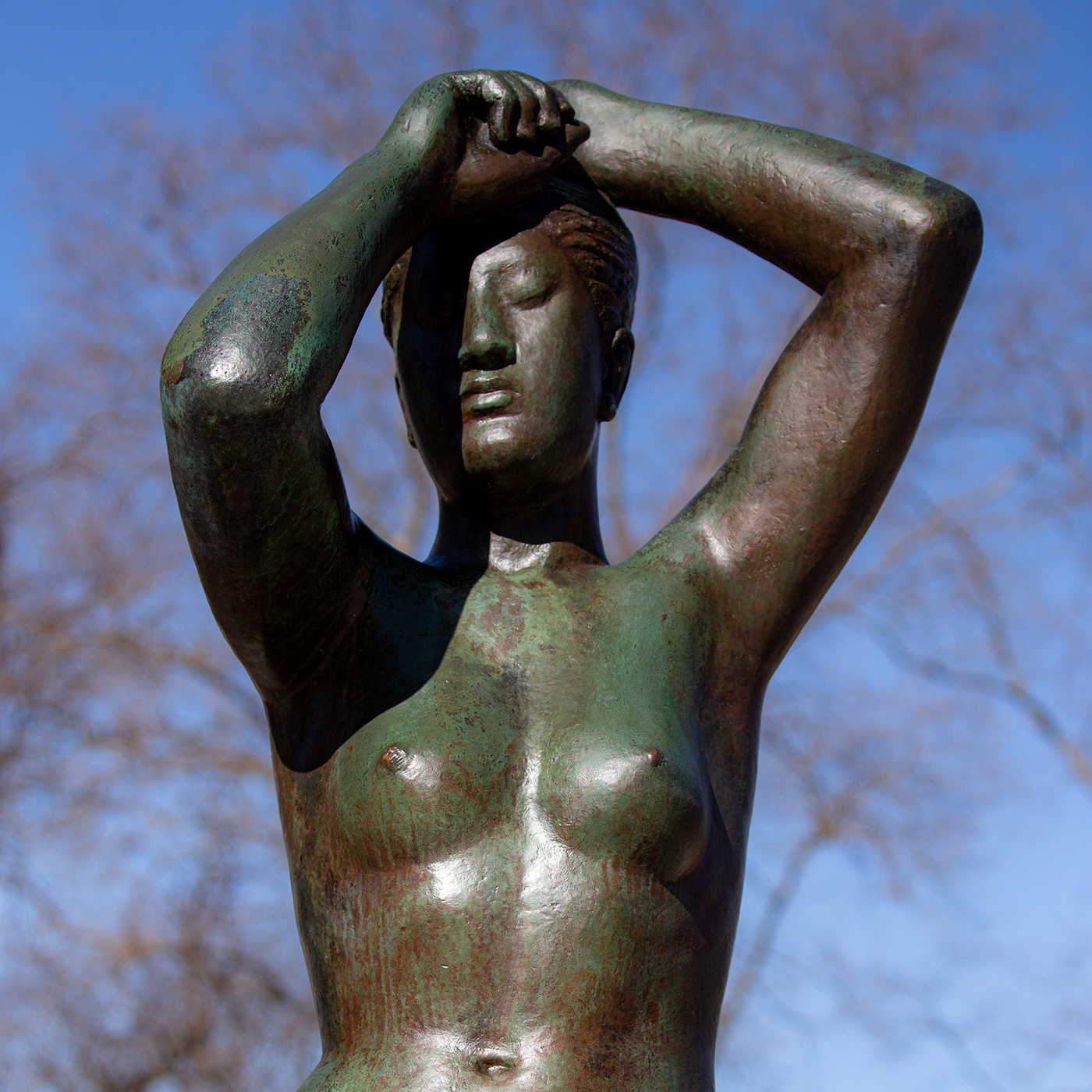
Maja (pronounced \\MAI-uh\\) by the German artist Gerhard Marcks was first exhibited in Philadelphia in 1949 at the Association for Public Art’s Third Sculpture International Exhibition at the Philadelphia Museum of Art, where the sculpture was exhibited prominently at the top of the Museum’s steps. This series of sculpture exhibitions in 1933, 1940, and 1949 featured works by hundreds of sculptors from around the world, and was organized by the Association to introduce the public to contemporary sculpture and to identify artists for the Ellen Phillips Samuel Memorial on Kelly Drive. Maja was considered a particularly significant sculpture in the exhibition – which included works by Alexander Calder, Jacques Lipchitz, Pablo Picasso, and Barbara Hepworth – and the Association decided to purchase the sculpture.
Maja went on to be part of another notable exhibition, Sculpture of the Twentieth Century. The Philadelphia Museum of Art was the first venue for the exhibition, which then traveled to the Art Institute of Chicago and culminated at MoMA in 1953. When Maja returned to Philadelphia, the sculpture was installed on the East Terrace of the Philadelphia Museum of Art until 1992, when it was removed and placed in storage due to the renovation of the terrace.
In March 2021, after decades out of public view, the sculpture was installed in a new public park, Maja Park, coming soon to the Benjamin Franklin Parkway. The development of Maja Park, designed by Ground Reconsidered, has been a private/public partnership between AIR Communities, which owns the adjacent Park Towne Place Museum District Residences, and Philadelphia Parks & Recreation, with support from the Commonwealth of Pennsylvania.
Born in Berlin, Gerhard Marcks (1889-1981) was a German artist who taught at the Bauhaus and helped revive the art of sculpture in Germany in the early 20th century. He is primarily known for his sculptures, but also for his drawings, woodcuts, lithographs, and ceramics. His figurative artworks, like Maja, never seem heroic or laden with pathos, but instead reflect humanistic moods and a quiet behavior.
The installation of Maja calls attention to the resolve of artists working under duress or persecution. Labeled a “degenerate artist” by the Nazis, many of Marcks’ sculptures were destroyed during WWII, as they were considered by the Nazis to be too expressive, disproportionate, and not serving the German Ideal. Marcks was subsequently barred from exhibiting or selling his sculptures, and a number of his artworks were confiscated, melted down, and repurposed for war materials.
Press
Artwork Credits
Purchased by the Association for Public Art (formerly the Fairmount Park Art Association)
Owned by the Association for Public Art
Artwork Media
Museum Without Walls
Voices:
DR. ARIE HARTOG is Director and former Curator of the Gerhard Marcks Haus in Bremen, Germany, which houses a substantial collection of works by artist Gerhard Marcks. His research focus is the history of 20th century sculpture.
DR. PAUL B. JASKOT is Professor of Art, Art History and Visual Studies at Duke University. His scholarly work focuses on the political history of Nazi art and architecture as well as its postwar cultural impact.
PATRICIA C. PHILLIPS is a public art scholar, curator, art critic, and an aPA trustee. She is the former Chief Academic Officer and Academic Dean of Moore College of Art & Design.
Producer: Alex Lewis
Videography: Greenhouse Media