


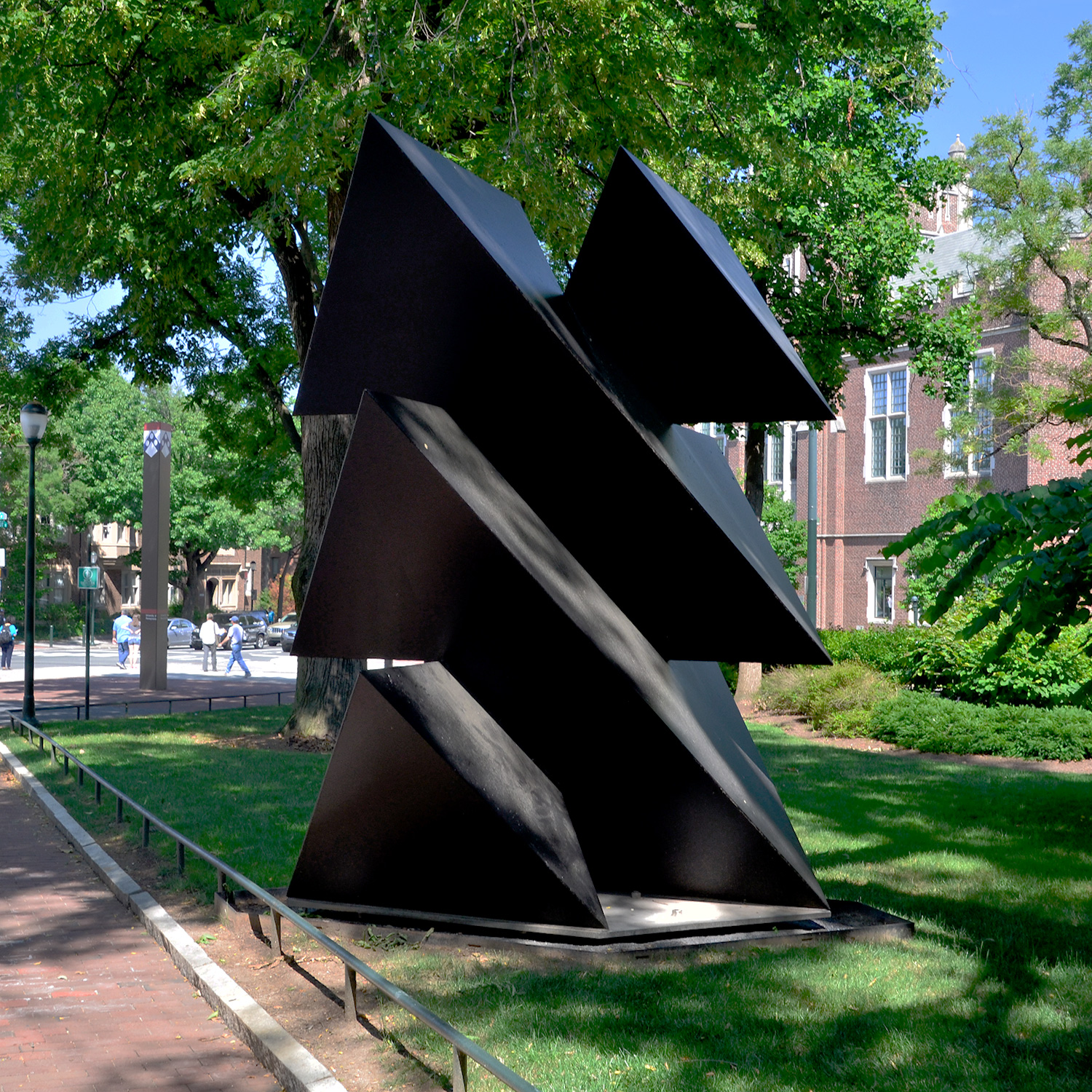
Artwork Details
- Title
- Black Forest
- Artist
- Robinson Fredenthal (1940 – 2009)
- Year
- 1983; installed 1984; relocated 2020
- Medium
- Steel 3/16" plate, painted black
- Dimensions
- Height 12'6″, width 4', depth 8'
Artwork Description
Known for his monumental works in steel, Robinson Fredenthal was fascinated by the mysterious patterns made by simple geometric objects when they are joined together, turned at new angles, or revolved through space. Philadelphia Inquirer art critic Edward Sozanski wrote that Fredenthal “spent a career translating the intellectual discipline that geometry imposes on the mind onto sculpture. . . .”
Fredenthal’s Black Forest on the University of Pennsylvania’s campus is a black painted steel sculpture with four interpenetrating pyramidal forms that depict the shape of an asymmetrical evergreen tree. As the viewer moves around the work, different sets of three-dimensional triangular shapes emerge, representing branches. The sculpture stands on two main pyramidal legs on its base, which is a stainless steel parallelogram attached to a concrete foundation.
The New Hampshire-born Fredenthal studied at the University of Pennsylvania’s School of Architecture. When a neurologic disorder (a form of Parkinson’s disease) made it hard for him to draw, he turned to sculpture. By the early 1970s, with the help of assistants, he was producing large-scale public works based on the cardboard models that filled his studio.
Fredenthal has a number of major public sculptures in Philadelphia, including White Water at Woodmere Art Museum (relocated from 5th and Market Streets) and Water, Ice, and Fire at 1234 Market Street.
Content on this page was adapted from Public Art in Philadelphia by Penny Balkin Bach (Temple University Press, 1992). Bach was the longtime Executive Director of the Association for Public Art, working with the organization from 1980 to 2022.
Artwork Credits
Private Gift of Philip and Dr. Muriel Berman
Owned by the University of Pennsylvania