


To Make Freedom Ring
An essay by Seph Rodney on Paul Ramírez Jonas’s artwork, “Let Freedom Ring,” presented in Philadelphia by the Association for Public Art
This essay originally appeared as a printed tabloid created for Let Freedom Ring. View the original printed piece.
The first time I encounter Paul Ramírez Jonas’s bell tower artwork on the sidewalk leading to the Cherry Street Pier in Philadelphia I’m impelled to think about the historic uses of bells. Before developing the modern habit of wearing personal timepieces, there were towering clock bells — typically installed in town plazas or in certain buildings of monastic properties — that helped people within a community coordinate their schedules, in particular, synchronizing the hours for labor and meals. Public bells also indicated the times for enacting religious rites, signaled the opening of markets, commemorated weddings and the passing of community members, and heralded public notices. Additionally, they could indicate impending danger such as invading armies and life-threatening natural disasters. Put another way, in the words of Paul Farber, one of the co-curators of Let Freedom Ring’s initial manifestation on the National Mall in Washington, DC: “The bell is a call to presence, a call to gather.” It is, and this invocation to assemble in order to inform each other, to think through a collective problem, or enact a coordinated response is at the root of civic culture.
It feels warranted, at this moment in the history of a nation still described as the great “experiment in democracy” to rehearse what I mean when I say, “civic culture.” This refers to that space of noncommercial public engagement that is distinctly different from the space of familial activity and religious fellowship and is in direct contradiction to the idea of “stranger danger.” Spaces of civic engagement allow us to meet people we don’t already know, though we share territory and resources, believing that we are better off knowing each other instead of remaining strangers. Here, our openness to communication leads to the possibility of thinking collaboratively and acting collectively. Without these actions this experiment might yet fail.
Ramírez Jonas’s conviction about Let Freedom Ring, is that it would provide an occasion for strangers in this improvised town square, to respond to the sculpture, exchange anecdotes about their experience, collaboratively make sense of it, and in these ways step into the role of the person who answers the call to convene, to pay attention. The artist means to welcome as many people into this square as he can.
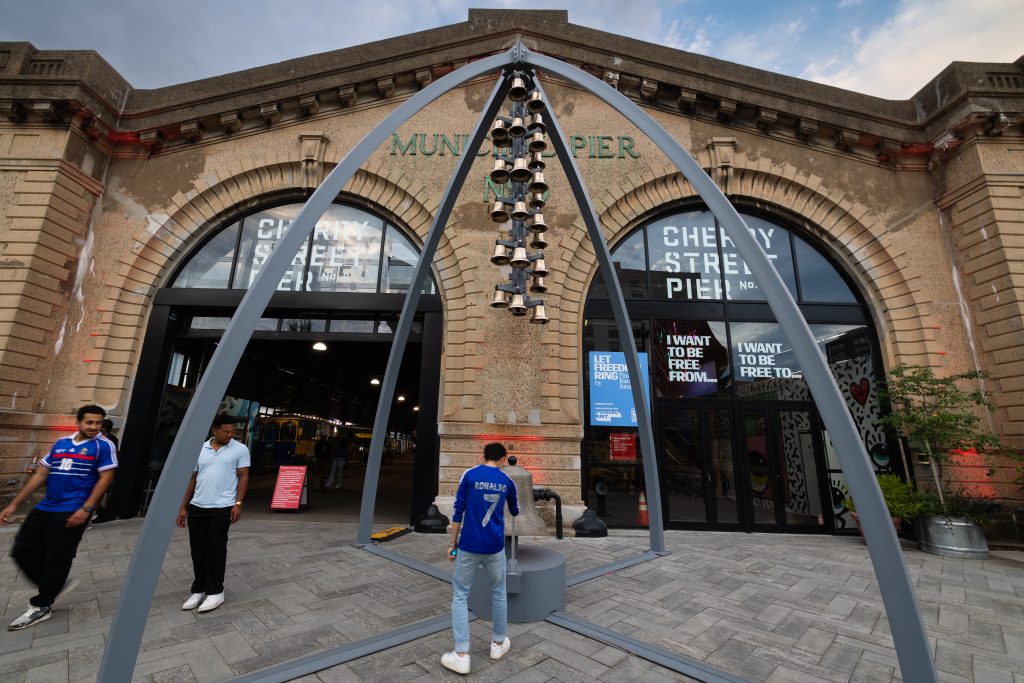
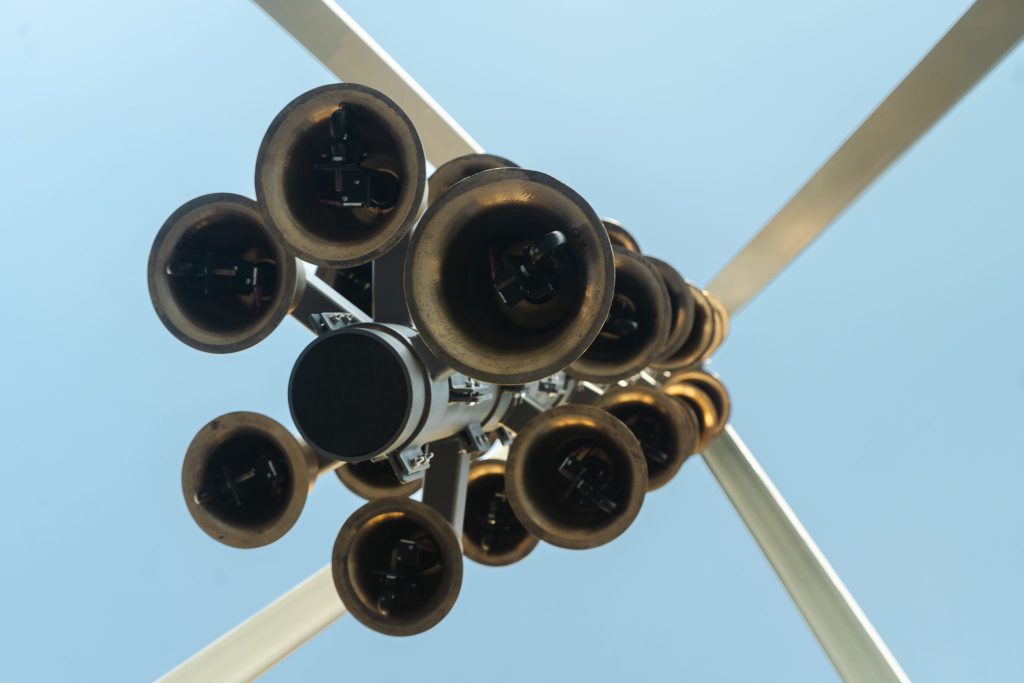
The inclusivity of Ramírez Jonas’s Let Freedom Ring is inherent to the sculpture’s structure. Its monumental, open design means as the artist promises, “You can come from every direction” to approach the work. Looking like a massive wind chime, four long, curved, minimalist steel arcs, widely spaced apart on the ground, meet about 40 feet in the air like the armature of an inverted cup. Descending from the central axis, are a string of small bronze bells, 32 of them, each with its own clapper to make it sing. Programmed to act in concert, they sound out almost the entirety of the song “America (My Country, ’Tis of Thee)” every fifteen minutes. But the last note is left unrung, waiting for the visitor’s intervention. At the base of the piece, in its center, a 600-pound bell is installed with a lever that is weighted in such a way as to, again, allow widespread participation. Ramírez Jonas says, “People have different bodies; there are little children, people who are very strong. We want to make sure we come with a striking mechanism that no matter who you are, you can ring this bell.” When the piece seemed to permit me to complete the line, I pulled the lever, which felt like picking up a ten-pound weight that slipped a catch and suddenly became buoyant. It clanged against the bell’s sound bow. I made freedom ring.
It is worth thinking about the significance of the song written by Samuel Francis Smith in 1831, which encapsulated the ethos of a burgeoning nation so resonantly that it served as an unofficial national anthem for one hundred years, until the adoption of “The Star-Spangled Banner.”
There are four verses within the original. Consider the lyrics of the first stanza which opens the song and with which you might be familiar:
My country, ’tis of thee,
Sweet land of liberty,
Of thee I sing;
Land where my fathers died,
Land of the Pilgrims’ Pride,
From every mountain side
Let freedom ring.
The first line means essentially “My country, it is of you that I sing.” Thereafter he begins setting out the reasons his spirit is so moved that he would break into song. He is making a kind of call to gather. Smith entreats the reader and listener to see with him what he sees in this land, to mourn with him the death of progenitors, to feel the pride of fighting for. Then his call extends to the natural world. Smith enjoins the land itself to echo back to him what he feels with ardent intensity. However, the liberty he extols, which he imagines reverberates from mountainsides throughout the landscape primarily exists as a facet of human relations. We bind each other in chains — literal, legal, psychological, theological, social, and political. We make each other and ourselves unfree. And when we realize that our personal freedom is bound up with the freedom of others we look to communal action to remedy this bondage.

On August 28, 1963, the civil rights activist and Baptist minister Martin Luther King Jr. sought to essentially call the entire nation to convene. (Paul Ramírez Jonas cites King’s speech as one of the inspirations of his work.) During the March on Washington for Jobs and Freedom King both implored and demanded civil and economic rights for people of color and an end to the country’s legalized racism. There he made his now famous “I Have a Dream” speech. He had heard Smith’s voice ringing in his ear and wove his own verses in response, departing from the prepared text to improvise the end of his oration. King quotes Smith’s first stanza and then states:
And if America is to be a great nation, this must become true. So
let freedom ring from the prodigious hilltops of New Hampshire.
Let freedom ring from the mighty mountains of New York. Let
freedom ring from the heightening Alleghenies of Pennsylvania.
Let freedom ring from the snowcapped Rockies of Colorado. Let
freedom ring from the curvaceous slopes of California …
There are some key conditionals King puts in place to question the ardor of blinkered patriotism who some in Smith’s time and some presently demand from its citizens. He says, “if” the nation is to be great, then this thing that he has been advocating for “must become true.” What must be true? To paraphrase the end of King’s speech, the answer is to have “black men and white men, Jews and Gentiles, Protestants and Catholics, able to join hands and sing.” At the time the language of the movement was not yet inclusive enough to acknowledge women, transgender people, or those of other races, ethnicities and faiths. But the good faith effort is there to cultivate a civic culture, to create mechanisms by which we call to each other and respond in time, by which we can hold hands in the service of making ourselves more free. The globe does not feature many multi-racial, multiethnic democracies. There are few nations like the United States. We are still a remarkable experiment the dream of which is not yet fully realized.
And what we mean by “freedom” deserves to be unpacked. One of the most deeply considered versions of liberty I’ve found is in Ursula K. LeGuin’s novel The Dispossessed. Here she makes the case through the story’s protagonist, Shevek, that freedom thoughtfully realized is conditional — it demands both the willingness to rebel against coercive systems and the moral imperative to participate in a community. The storied version of America’s fight for freedom via violent resistance to the British crown and rejection of their rule is well known. The story the nation constantly tells itself is that this is where its true heroism is found. But Let Freedom Ring insists on something else: participation, not just freedom from, but freedom to, freedom to be meaningful to those around you, to be one of the townspeople who helps spread the word of the coming fire. You do not have to die for freedom to be a fighter for it.
I visited Let Freedom Ring a few times. Curiously, when I crossed the boulevard that runs adjacent to the pier to walk further inland, I could only faintly hear the bell sounds calling me. The noise of motorized transport almost erased them from 100 feet or more in distance. In this way their call is obscured. I wonder what else exists in our polity to block and cloud our calls to gather, to collectively make sense of where we are and what we are doing. You must hear the bells to respond to them. Are you listening for them now? You must be willing to pull the lever to complete the song once you hear it. Will you? Will you make freedom ring?

About Seph Rodney
Seph Rodney, PhD is an arts writer and editor who also curates visual art exhibitions. After several years at Hyperallergic, first as a staff writer and then as an senior art critic and opinions editor, he went freelance and has written on art and culture for The New York Times, CNN, NBC, The Guardian, Art Forum, and Art in America. He wrote The Personalization of the Museum Visit, which was published by Routledge in 2019. In 2025 the book he co-edited Artists as Writers: Living and Sustaining a Creative Life was published by Intellect Press. In 2024 he co-curated the largest show to date mounted at the San FranciscoMuseum of Modern Art, which subsequently traveled to Crystal Bridges Museum in Arkansas, and the Pérez Museum in Miami. He is now at work on a book about learning how to look at art, tentatively titled A Certain Minor Light. He currently teaches a course on art criticism at Brown University.
Photos by Nonni Human and Steve Weinik
Major support for Let Freedom Ring is provided by The Pew Center for Arts & Heritage. Additional support provided by the Philadelphia Funder Collaborative for the Semiquincentennial.